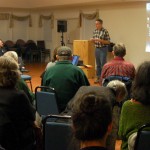
We had around 50 people come out on a foggy night in Powell River BC’s Cranberry neighbourhood for our guest speaker Tom Shandel’s film screening and discussion. We were very lucky to have Tom’s experience and insights into the co-op/credit union world.
We thank First Credit Union and their representative Tara Chernoff for their support on what was Credit Union Day (Oct 17), and all our participating members, especially Aaron Mazurek and family for hosting Tom Shandel and his partner, as well as to Jacqueline Huddleston for putting out an appie extravaganza and for her general tireless work for our cooperative.
Many thanks also to Jan Burnikell who is also always there as a constant support. Kudos also to our Skookum guest speakers/co-organizers David Parkinson (Secretary, Past-President), Laura Berezan (Treasurer), and to all those who showed up with equipment and assistance in setting up/tearing down, and driving us around to get this event happening.
We do have an audio recording of the event, that needs to be edited. Skookum has a copy of the film we viewed, plus 2 other versions that relate directly to Social Co-ops (elder care, drug rehab co-ops, especially), and to the Emilia-Romagna, Italy model. This DVD and another title by Tom Shandel will be made available to members through our Skookum Bookshelf (our lending library that you should really check out and even contribute to…) at Kingfisher Books on Marine Ave., shortly.
If you missed it… here is the dynamic slideshow that preceded the event, click here.
Tara Chernoff ‘s very relevant and timely reference to a Tyee article on 5 Things we Don’t Know About Co-ops, and you can read it right here.
And here is a version of the film (but not exactly the one that played last night) here in two parts:
Click image for larger version pdf. Please feel free to print a copy and put one up somewhere. OPEN TO ALL. We are asking for $5 donation at the door.
Please join us at the Cranberry Seniors’ Centre on Thursday, Oct 17 at 6:30 PM (show at 7:00 PM) for an evening with Tom Shandel, visiting film-maker, producer, writer, and board member of Duncan BC’s Cowichan Co-operative Connections, for a screening of his short documentary film Civilizing the Economy (read on below) and clips from some of his other work, plus a discussion on building and maintaining cooperatives in our region and beyond.
This event is co-sponsored by Skookum and First Credit Union to celebrate Co-op Week (Oct 13-19) and Credit Union Day (Oct 17). Everyone is welcome to attend; arrive early as seating is limited, plus we will have some delicious snacks conjured up by Chef Jacqueline Huddleston. A $5 donation at the door is much appreciated, as this is a fund-raiser for future Skookum projects.
Click image to view trailer
“Civilizing the Economy
The Corporation documentary showed us how bad they really are. But there is an alternative way to organize enterprise better than no-public-liability en-corporations. And it’s been around for years…and built a lot of western Canada. How come we stopped?
Produced for British Columbia Cooperative Association and directed by Tom Shandel, written by John Restakis with strong support by Robert Williams, CIVILIZING THE ECONOMY, narrated by Patrick Watson, shows there’s another way to do business in a more or less free market: COOPERATIVES! CIVILIZING THE ECONOMY explores one of Europe’s most successful economies, featuring three interdependent sectors, private, public/state and cooperatives. ” From: http://shandel.ca/?page=Civilizing%20the%20Economy
This third instalment on cooperatives will take a more personal approach to the topic: namely, why I became a member way back when (3 years ago or so) and what my personal motivations are in seeing Skookum develop and increasingly become a big part of our community, and a draw for the like-minded out there looking for a great place to live.
Other points of view are encouraged on this blog as well, so if you want to share, please contact us with your story or simply comment on this one, at the bottom of the blog post.
In 2009, while our trusty economy was taking its latest major dip, a small group of us got to talking about how to increase our community’s confidence in being able to feed ourselves. The ‘food insecurity’ was and still is, caused by various factors like volatile food prices and the constant low-level awareness that as a remote community producing probably no more than 4% of our food, we could be in big trouble and fast. Other areas of concern are the effects and costs in both today-dollars and future costs to the environment and our health inherent to fossil fuel use in food production/transportation. Coupled with the growing local interest in food self-sufficiency in terms of growing, raising, catching, preparing, preserving and sharing the best food possible, made it seem like a good time to try something new.
Underlying this was the need to great create stronger community links between people with resources and skills and those who could gain from these, for the benefit of all. We saw the newly developed non-profit Community Service Cooperative designation as providing a great model for democratic ownership. Even before we had the Skookum name, we had the feeling that the group would grow to include many different types of activities that would support local food and also create links between people with a concern for related progressive society-building activities like affordable housing, collective ownership of land, materials, vehicles, structures and resources. Any profits raised from our group’s activities goes back into the cooperative, and with no membership fees (except for the initial one-time purchase of an actual share at $20 that is also redeemable), the cooperative was meant to provide open access to jointly-owned resources.
So what do you do? Who do you benefit? What can I get out of this?
The one-line ‘elevator speech’ describing Skookum is a pesky critter: the fact is that the cooperative was designed to be what the membership wants it to be, provided that our core goals of helping our members “acquire and share the knowledge, skills, and resources they need in order to grow, gather, raise, and catch healthful food as locally as possible and to preserve, store, prepare, and share the bounty”. That’s a mouthful. I like to say we’re here to help make local food happen, however we can. If a member wants to run a lending library of books (we have this at Kingfisher Books) or tools, run workshops on growing rabbits, catching fish, canning tomatoes, growing or picking mushrooms, baking bread, or run a bulk buying project that will help members get the best possible food or food-related product (seeds, plants, trees, growing or preserving supplies) at reasonable prices, they should be able to do so and get payment from those members or non-members who want to participate.
If you went on the local Edible Garden Tour this year (kicking off the Annual 50-Mile Eat Local Challenge), you visited several Skookum members’ gardens, saw our Skookum cider press (the morning part of the tour) and probably talked with many Skookum members too! We have 137 memberships comprising 186 members at this point and we’re always looking for activemembers to increase the scope and to work on existing projects that need support. Tell your friends!
This is Part 2 in a short series on cooperatives, and specifically on Community Service Cooperatives, because that is the designation for Skookum.
As a cooperative, we adhere to all the rules as described here (there are 171 of them) based on the BC Cooperative Association’s Regulations. This includes the fact that cooperatives are owned by their members (that’s one member=one vote, as opposed to being based on amount invested/donated, making cooperatives very democratic entities), and that each member holds a stake in the cooperative, that can be redeemed at any time. At Skookum, this is represented by your share certificate that costs $20.
The gist of it: What’s A Community Service Cooperative?
The purpose of a Community Service Cooperative can be either charitable or to provide health, social, educational or other community services to members, with a responsibility to the wider community. While Skookum is a non-profit cooperative organization, we are eligible via this new Community Service Cooperative designation, to apply to the Canada Revenue Agency for charitable status, if we so wish.
Assets collected or donated may only directly support and grow the cooperative (providing members with services and access to information, events, tools, land, supplies etc.), Skookum cannot return profit shares to members (unlike Mountain Equipment Co-0p or First Credit Union), whether on a periodic basis nor upon dissolution of the cooperative.
If the cooperative were to dissolve, members would receive their initial share price, after satisfaction of its liabilities and the costs, charges and expenses properly incurred in the dissolution or winding up. Any further assets must be transferred to or distributed among one or more community service cooperative or a registered charitable organization.
Skookum is concerned with increasing the amount of food available locally, regardless of how it comes to people:
Grown: any kind of produce, grains, beans, etc.
Gathered: wild foods, gleaned fruits nuts, etc.
Raised: animals other domesticated food sources;
Caught: wild animals, fish, etc.
The Triple Bottom Line: Healthy Community: we intend to produce benefits for the social life of the community, through the strengthening of ties among people, by respecting and honouring the work that people do to feed themselves and others; Economic Vitality: we intend to produce economic opportunities for people, embedded in a vision of a fair and just economy which pays fair prices and fair wages; Natural Environment: we intend to minimize waste and destructive practices as we go about our work.
In practical terms, the cooperative’s members are encouraged to reflect Skookum’s commitment to the three pillars of the Triple Bottom Line (social, environmental, economic) by creating and supporting projects that help members to grow, gather, catch, raise, preserve, prepare and share healthful food as locally as possible.
As a cooperative, Skookum is a ‘bottom-up’ organization that relies on the energy and ideas of its membership to address this Triple Bottom Line through engagement at the levels of governance, project management, and participation in the projects or events we develop/participate in.
Skookum has no paid staff, but projects are expected to provide for coordinator remuneration, while addressing our core values and purposes, and providing a percentage toward Skookum operating costs. Recent projects include a member-run bulk purchase of fruit trees, ongoing Tattler lid sales, Cover Crop sales, and The Abundant Pantry Bulk Buying Club (now offering Cafe Justicia fairer-than-fair trade coffee, and always more local products), but also the recent get-together and plans for more informational/fun events like seasonal potlucks, film screenings and guest presentations in the fall/winter to come. We are also planning another round of our yearly ‘Apple Cider Press-a-Thon’ at the 2013 Powell River Fall Fair on the weekend of September 21-22.
We are seeking helpers for this as well as materials to make it work even better, so contact us with how you want to help out or click here and come up with your own Skookum project; check this page out for inspiration.
Time for a primer on cooperatives, because apart from knowing you’re a valued member of Skookum and that you gain value from our cooperative, it’s important to know what we are creating together. This little review includes the different types of cooperatives out there, how Skookum bridges several types (while primarily being classified as a Non-profit Community Service Co-op, primarily engaged in the Consumer Co-op model; see below) and what your role is in the whole thing. Consider this part one of a multi-part series on cooperatives. Cooperatives are becoming much more popular, and in future posts, we will discuss why that is.
The information below was culled from the British Columbia Cooperative Association website (we maintain membership in the BCCA) and from the Canadian Cooperative Association.
Types of Co-ops
Co-operatives are unified by their democratic structure, but different co-ops may be set up for different purposes.
Consumer co-operatives: These are co-operatives whose members are their customers; the majority of consumer co-operatives are retail stores. Mountain Equipment Co-op, UFA and the local retail co-ops that are part of Federated Co-operatives Limited, Co-op Atlantic and Arctic Co-operatives Limited are examples of consumer co-operatives. Housing co-ops, carshare co-ops, funeral co-ops and other types of service co-ops are also consumer co-operatives. At Skookum we have ‘Consumer co-operative’ as one of our models for The Abundant Pantry Bulk Buying Club (TAP) and for bulk purchases of seed, trees, Tattler canning lids, and food dehydrators ( interested in heading a project? Click here).
Other models we dip into have to do with community education, with the potential to engage in cooperatively purchased land, tools, and a host of other things that would grow out of our mission, values/principles and purpose statements.
Financial co-operatives: Credit unions and caisses populaires are examples of financial co-operatives. Like consumer co-operatives, the members of financial co-operatives are the individuals or business owners who use their services. Another type of financial co-operative is The Co-operators, an insurance company which is owned by Canadian co-operatives, credit union centrals and like-minded organizations.
Producer co-operatives: These are groups of producers who band together to process and/or market their products. Agricultural co-ops like Gay Lea Foods, Agropur, La Coop fédérée, Organic Meadow, Scotsburn Dairy, Farmer’s Dairy, Northumberland Dairy, Citadelle, Granny’s Poultry and Organic Meadow are examples of producer co-operatives.
Worker co-operatives: These are businesses owned and controlled by their employees. La Siembra (Camino chocolate products), Just Us! Coffee Roasters, The Big Carrot and the Vancouver Renewable Energy Co-op are examples of worker co-operatives.
Multi-stakeholder co-operatives: These co-operatives include different categories of members who share a common interest in the organization: for example, clients, employees, investors and community organizations. Multi-stakeholder co-operatives in Canada include Common Ground Co-operative, which provides employment opportunities for people with developmental disabilities; the West End Food Co-op, a Toronto co-op owned by consumers, producers and employees, and the Aylmer Health Co-op, formed by citizens, doctors and health professionals to improve community health services in Gatineau, QC.
Mutuals and co-operatives: Mutuals, which in Canada exist primarily in the insurance sector, are governed by different legislation than co-operatives but operate under a similar business model. Both mutuals and co-operatives are independent associations of individuals who have voluntarily come together to fulfill their economic or social needs through co-ownership in a democratically-run organizations. Source: http://www.canada2012.coop/en/what_is_a_cooperative/Types-of-co-operatives
Click above for a list of some popular Canadian cooperatives.
Skookum Food Provisioners’ Cooperative is a Community Service Co-op
Since April 2007, an amendment the BC Co-op Act means that “non-profit” co-ops can now be incorporated as Community Service Co-ops and have similar status to non-profit societies. The change made community service co-ops eligible for charitable status via CCRA. Skookum has this designation, but at this time we are not seeking charitable status, but this is certainly a possibility for the future.
The Community Service Co-op designation ended the confusion arising from uncertainty surrounding the legal status of non-profit co-ops, while affirming the democratic structure of member ownership and control that is unique to the co-op model.
As a Community Service Co-op, Skookum’s Memorandum of Association includes all of the following non-alterable provisions:
That the co-op is a community service co-operative,
That the co-op will not issue investment shares,
That the co-op’s purposes are charitable or to provide health, social, educational or other community services,
That upon dissolution, the co-op’s property must be transferred to another community service co-op or a charitable organization,
That no part of the property of the co-op is to be distributed to members while it is in operation.
Want to start your own cooperative? Here’s a guide: placeholder